Robotiq 2F-85 gripper
The Robotiq 2F-85 is a two-finger adaptive gripper with an 85 mm stroke. It sits on the Gen3’s wrist and is driven through the arm’s interconnect, so it has no cable or network address of its own.
The numbers below were measured on one 2F-85 on the Dojo cell on 2026-10-29, with the gripper only and no arm motion, except where a section says otherwise. Another unit may differ slightly: re-measure yours before relying on a timing-critical constant. Distances in mm are position × the 85 mm stroke.
Commands and feedback
A command has three values, each 0..1:
| Value | Meaning |
|---|---|
position | 0 is open, 1 is closed. |
speed | The finger speed. See Speed: 0 does not move the fingers. |
force | A ceiling on the motor current, not a force setpoint. |
The gripper latches the last command: it keeps the last position, speed and force until it receives a new one.
It reports its position (0..1) and its motor current, in amperes and as a fraction of the maximum current. Neither is a force in newtons.
Position feedback occasionally reads exactly 0.0 in the middle of a stroke: about 1 sample in
3,000 at 20 Hz, and 1 in 10,000 at 50 Hz. Don’t act on one sample alone.
How it moves
The velocity profile of a move is a trapezoid with nearly vertical edges. The fingers start about 50 ms after the setpoint, run at the commanded speed, and stop dead on the setpoint with no overshoot.
Speed
For any speed > 0:
finger speed ≈ 20.9 + 128.4 × speed mm/s (speed ≤ 0.75; ±0.5 mm/s)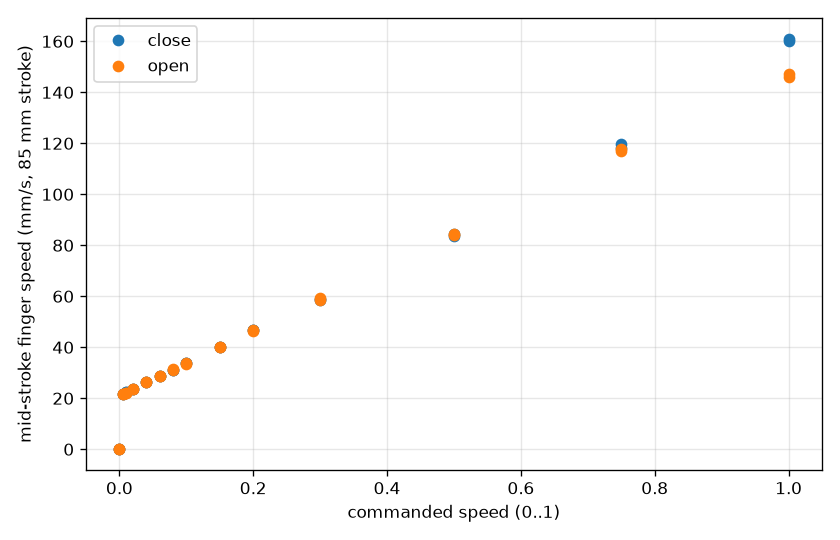
| speed | 0 | 0.005 | 0.01 | 0.1 | 0.2 | 0.3 | 0.5 | 0.75 | 1.0 |
|---|---|---|---|---|---|---|---|---|---|
| mm/s | 0 | 21.8 | 22.2 | 33.7 | 46.6 | 58.9 | 84.1 | 118 | 161 closing, 147 opening |
- There is a floor, not a dead band.
speed0 does not move the fingers at all, and anyspeedabove 0 moves them at about 21 mm/s or faster. The 2F-85 cannot move continuously slower than that. - Closing and opening run at the same speed up to 0.75. Above that, closing is faster.
forcehas no effect on free-air speed.- Repeats agree to ±0.1 mm/s.
Latency
From setpoint to first finger motion, through the arm’s interconnect: 42–55 ms median, p90
under 60 ms, worst case 68 ms. Closing is about 7 ms quicker than opening. The
speed setting has little effect.
Position
- Accuracy: after a move, the reported position equals the command to within one step of 1/255 (0.3 mm).
- Repeatability: repeats show no spread, and approaching from either direction lands in the same place.
- Full close: in free air, a full close reads 0.991.
- Gap in mm: the mapping from position to the physical gap between the fingers has not been measured.
Restarting
Once the fingers have stopped, they wait about 0.1 s before following a setpoint that has
moved on. This causes the stair-steps you see when you stream a position ramp with a speed
faster than the ramp itself: the fingers catch the setpoint, stop, wait, and jump. Each step is
about the ramp’s rate × 0.1 s.
Contact
On an object the fingers stop dead, so position is the signal to watch. Once they hold, the
current drops to about 0.05 A whatever the force, so current sampled at 20 Hz tells you
nothing about a stall. At force 1, though, the fingers keep creeping for up to 0.6 s as they
squeeze.
Detecting the stall from position:
- two unchanged samples at 20 Hz: 0.10–0.14 s after the stop;
- three unchanged samples at 50 Hz: 0.06 s after the stop.
Commanding it smoothly
To reach target in T seconds without stair-steps:
- The rate:
rate = |target − current| × 85 mm / T. - At 21 mm/s or faster: send
targetitself atspeed = clamp((rate − 20.9) / 128.4, 0.01, 1). The fingers make one continuous move and arrive about 50 ms afterT. Do not stream a position ramp with a higherspeed: the fingers keep catching up to it and stair-step. - Slower than 21 mm/s: the fingers cannot go that slowly. Stream the position ramp at 50 Hz
with
speed0.01. They follow it in 0.3 mm steps, which looks continuous, and arrive on time. - A step: send the target at
speed1. - Settling: the fingers are done once they are within 0.01 of the target. If they stop short (on an object), they are done once they have been still for 0.1 s (two samples at 20 Hz). Don’t judge stillness until about 0.15 s after the command, to cover the latency.
On the arm, the gripper moved 0 → 0.8 while a cuRobo trajectory moved the tool 15 cm in 2.1 s. One setpoint at the computed speed finished 3–17 ms after the arm, 0.16 mm off a straight line. A position ramp streamed at 3× the needed speed finished 60–120 ms late, in 3–4 mm steps.
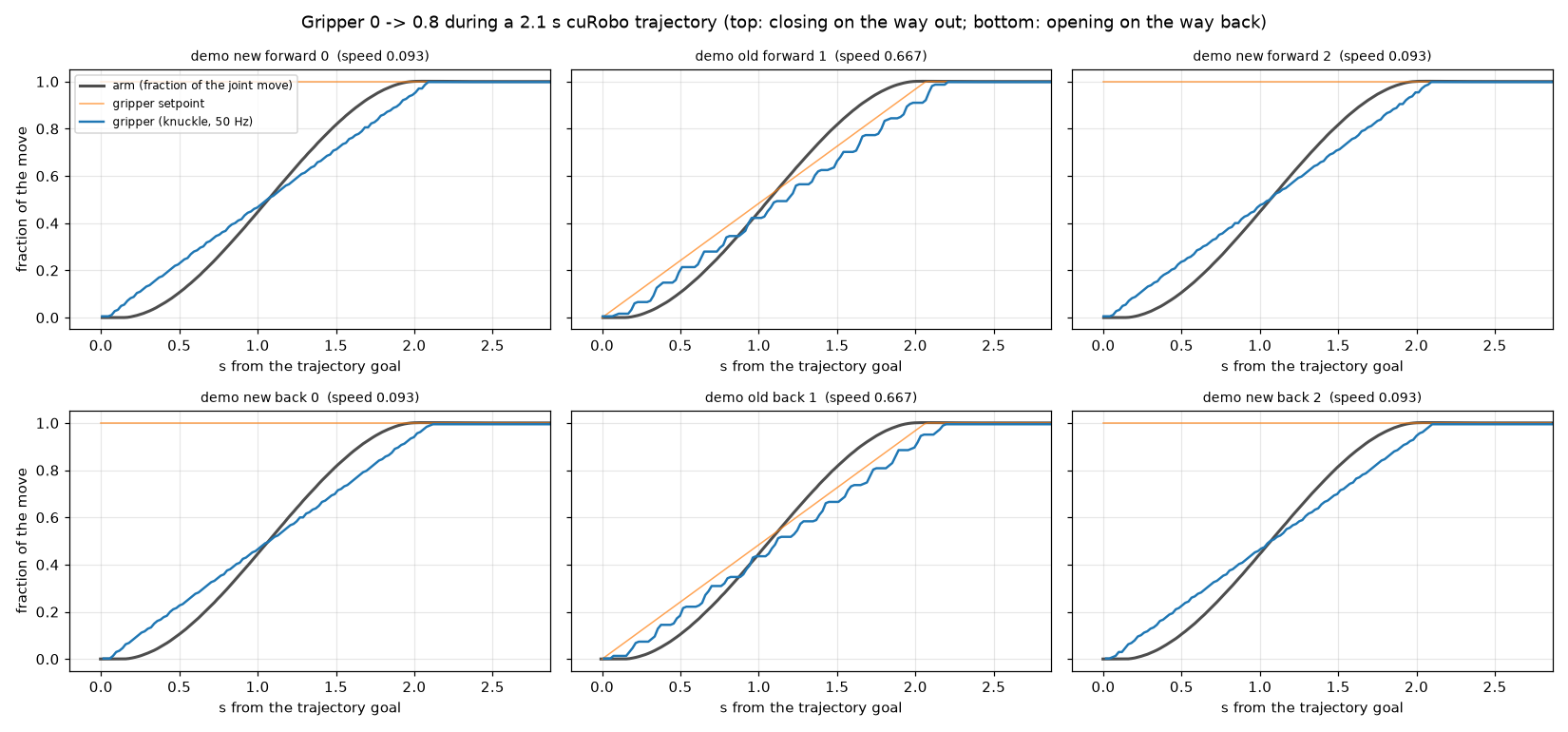
The gripper moves at a constant speed while the arm follows cuRobo’s smooth profile. They start and end together, but in between they are up to about 15 % of the move apart.